

LinkedIn Comment-Gating as a Growth Tactic
Explore how LinkedIn comment-gating quietly does what most funnels fail to do: capture real intent leads across social platforms, and why you should too before it gets overcrowded.


These days, when I open LinkedIn, I see 3 out of 10 posts following this format.
“Comment XYZ, and I’ll send you the playbook.”
“Comment ‘interesting’ for the link.”
“Drop a 🔥 in the comments and I’ll DM you the resource.”
And these numbers keep improving, whether on LinkedIn, X, or elsewhere.
Though the posts are enticing and deliver some value, there’s nothing special going on in the comments section. Well, except an endless scroll of:
“Interested”
“Interested”
“Interested 🔥”
“INTERESTED”
“interested pls...”
You see one of these posts, your FOMO kicks in, and you’re riding that ‘Interested’ bandwagon, too.
It feels like muscle memory now.
Sure, it does get a bit annoying, but hey, it works. It works great!
Creators are using this comment-gating or comment-to-access tactic to good effect.
And the audiences get it.
But you still won’t see it as a native feature on a platform like LinkedIn, which may treat it like an underground growth hack, when it’s not!
So, this begs the $million−dollar$ question.
Why hasn’t it been formalized as a native feature yet?
In this article, I’ll shed light on how this lesser-known distribution can become a powerful growth lever.
But first, let’s build on how comment-gating works.
How Comment-Gating Works
At its core, comment-gating is a three-step behavioural loop driven by curiosity and intent.
Step 1: Curiosity-Driven Content
Creators start by posting something that triggers curiosity or perceived value:
A framework or playbook
A partial insight
A before/after result
A teaser screenshot
A contrarian take
The post is incomplete by design. It hints at value without fully delivering it.
For instance, here’s a LinkedIn post I engaged with recently.
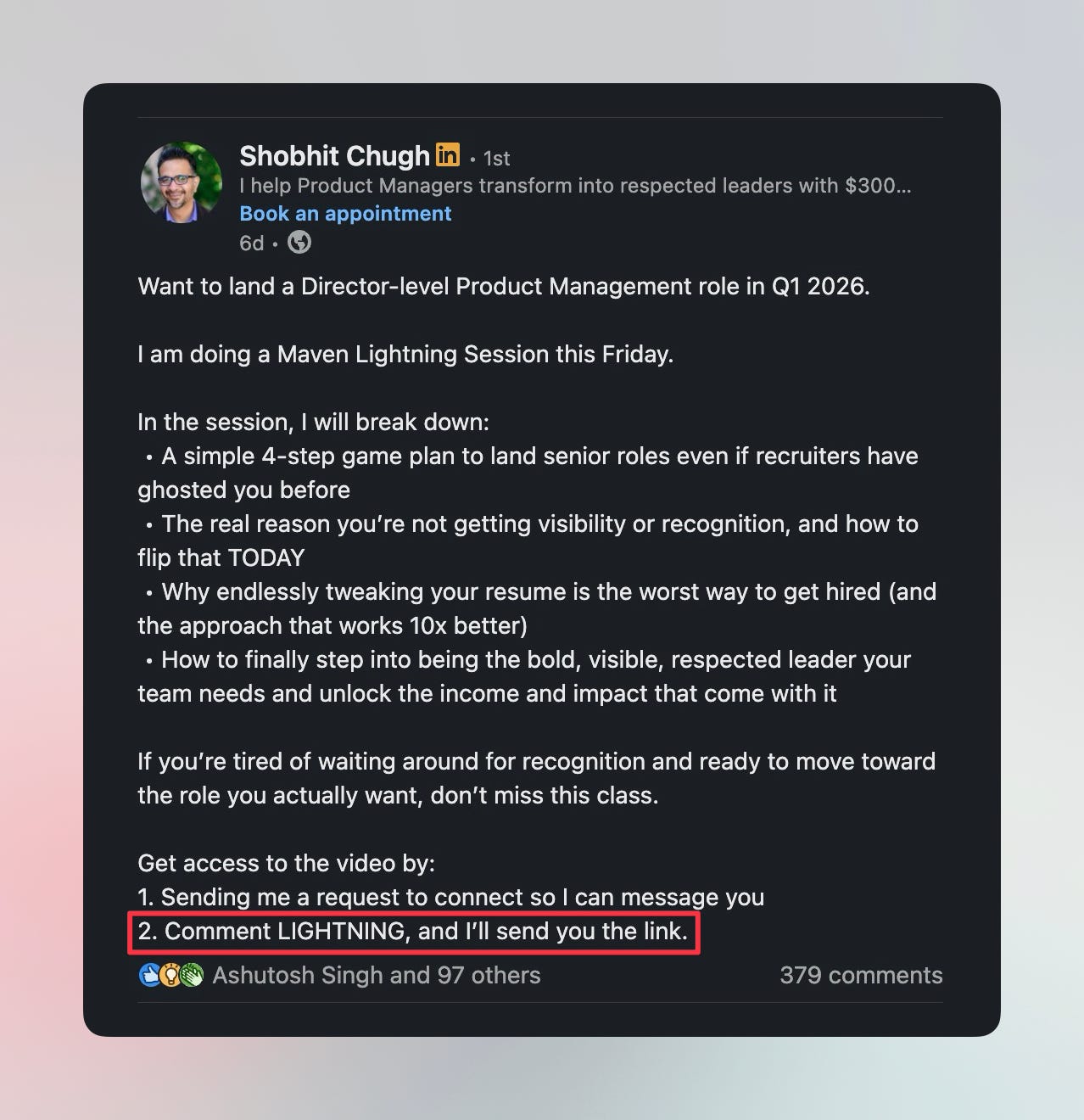
Step 2: Explicit Comment Prompt
At the end of the post, the creator adds a clear instruction:
“If you want access, comment XYZ.”
“Comment LIGHTNING, and I’ll share the link.”
It initiates a micro-commitment and converts passive viewers into active participants.
Check the highlighted section in the image in Step 1.
Step 3: Asset Delivery via DM
Once the comment is posted, the creator either:
Manually replies or sends a DM after connecting, or
Uses automation tools/bots/scripts to detect keywords and auto-respond. It’s where the 3rd-party layer comes in. Things make or break post this step (more on it later).
The asset (playbook, doc, video, Notion link, etc.) is then delivered privately.
Here’s the link I got for Shobhit’s Maven session.
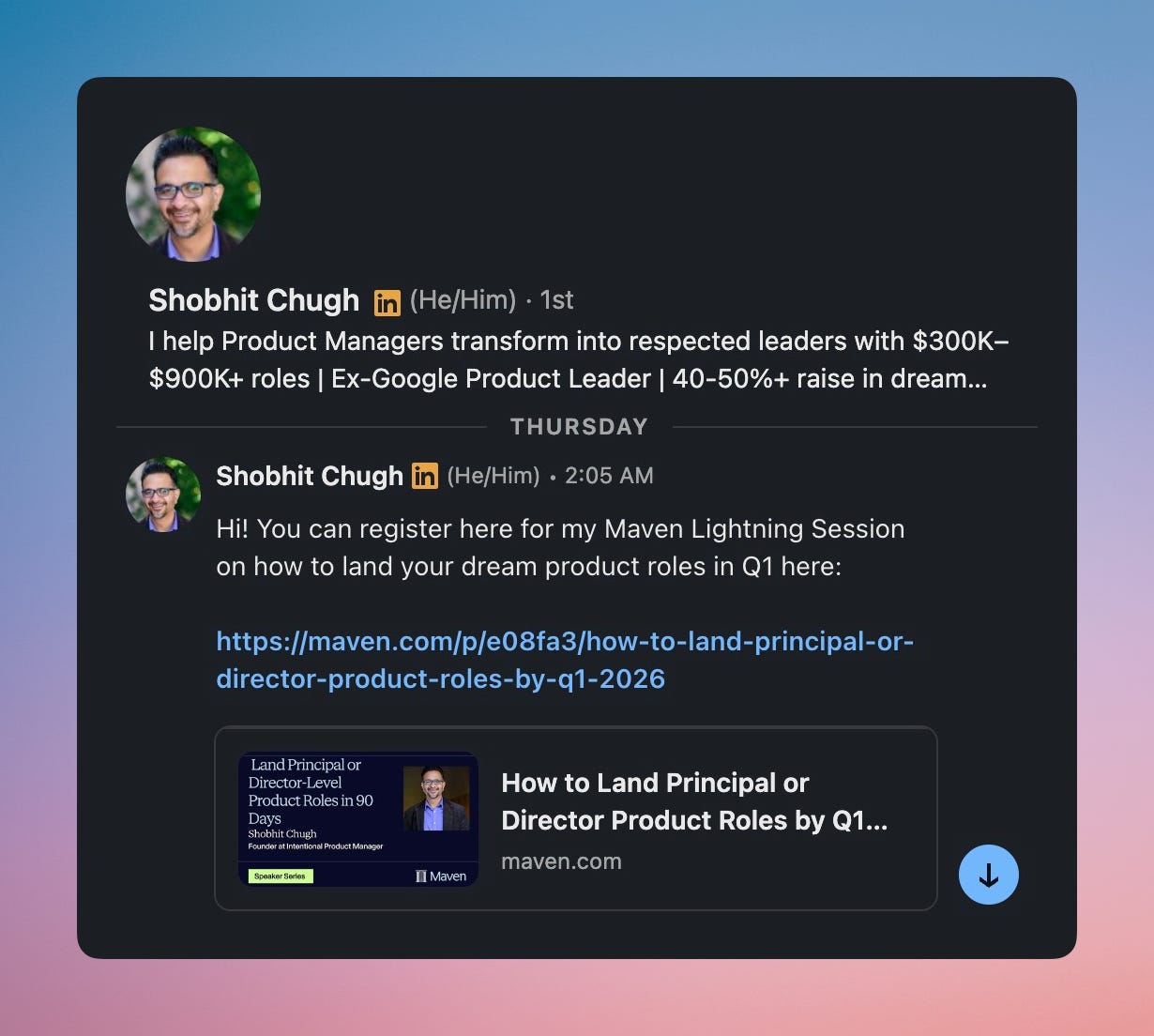
The delivery is where you’re starting a relationship.
It’s inbound, subtle, and powerful.
Comment-Gating: High-Intent Growth Lever
From a growth and lead-generation perspective, comment-gating is unusually powerful. Here’s why:
1. It filters for intent, not just attention
No cold DMs.
No, “Just circling back.”
No 7-step funnels.
People come to you.
You see, Likes are cheap. Views are passive. Even follows can be casual.
A comment, however, especially one with a specific keyword, is different. It’s them saying:
“Yes, I’m opting in. Please talk to me.”
And that’s not just engagement. That’s permission.

It signals:
Interest in the topic.
Willingness to engage publicly.
Readiness to receive more information.
It’s self-qualified intent and not inferred.
2. It adds a friction that improves lead quality
Comment-gating outperforms:
Link-in-bio
Cold DMs
External landing pages
Traditional lead magnets rely on users clicking links:
Click → land on page → maybe convert.
Comment-gating adds friction before access:
User reads the post → decides if the value is worth it → comments publicly → waits for delivery.
Every step filters out low-intent users.
The result: fewer leads but higher-quality ones.
And because the lead comes to you, it becomes easier to sell.
3. It strengthens Creator → Audience relationships
Because delivery happens via DM, it:
Opens a 1:1 direct channel.
Eases the follow-up conversation using feedback loops.
Humanizes the exchange.
Plus, creators can invest more time in high-value assets, improving content quality over time.
And they could measure demand instantly via comments.
Trade-Offs Platforms Are Facing
You may be wondering if comment-gating is so effective, why haven’t platforms embraced it yet?
The answer lies in legitimate platform-level concerns.
1. Abuse & spam risk
Without guardrails, creators can:
Gate low-value content → more noise.
Over-prompt comments → annoyed users.
Turn feeds into keyword farms → eroded trust.
2. Comment quality degradation
For platforms that value “professional discourse” (LinkedIn especially), it becomes a reputational risk.
Here’s another LinkedIn post I engaged with. Lots of comments, as you can see.
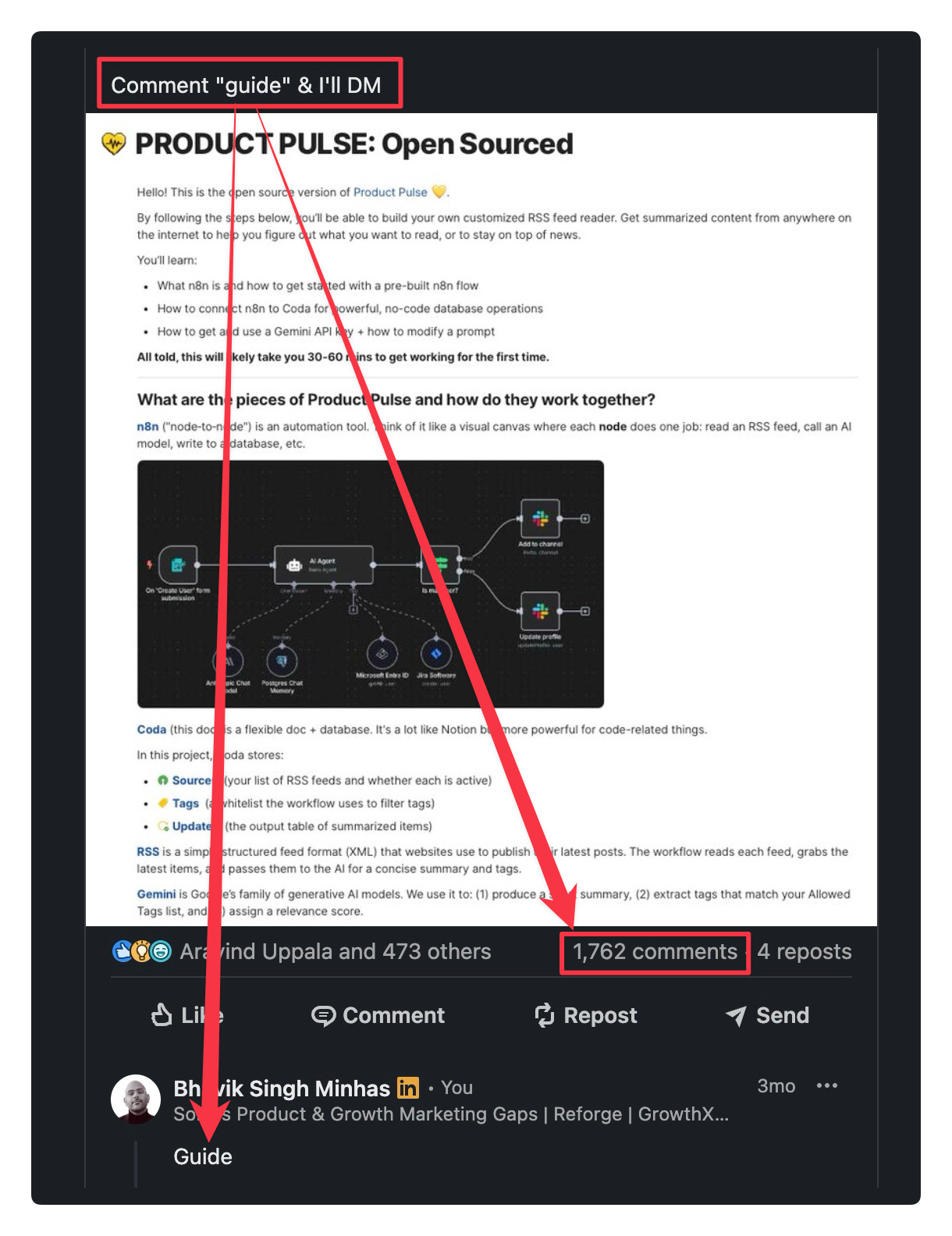
When comments become transactional (“XYZ”, “interested”, emojis), the signal-to-noise ratio drops.
Though these threads look busy, they aren’t insightful.
It doesn’t really shout thought leadership.
3. Engagement inflation without depth
Aka fake engagement.
From an algorithmic perspective, though the comment volume spikes, the semantic value declines.
It’s a classic case of distorted ranking signals.
But I’m not sure if LinkedIn cares about it, considering they also have their Puzzle games, which arguably offer little to no value, except boosting vanity metrics.
All said, it’s kinda ironic how comment-gating despite its concerns keeps users on the platform longer.
And this ensures platforms, like LinkedIn get what they secretly want:
More interactions
More DMs (which platforms love)
More session depth
This directly aligns with platform goals, and it’s the part where platforms should go:
“Wait… this helps us too, no?”
Yes. Yes, it does.
Why Comment-Gating Should Become an Official Feature?
It’s ironic how comment-gating keeps users on the platform longer.
And the platforms, like LinkedIn, get what they want:
No outbound clicks
More interactions
More DMs (which platforms love)
More session depth
This directly aligns with platform goals, and it’s the part where platforms should go:
“Wait… this helps us too?”
Yes. Yes, it does.
The behaviour is already entrenched.
The tooling is already being built, just outside the platform.
That’s usually a strong signal that product-market fit exists, but the product hasn’t caught up.
What a Native Feature Could Look Like
Imagine a built-in “Comment-to-Access” module:
Creator uploads an asset.
Selects a trigger comment or button.
The platform handles comment detection, asset delivery, rate limiting, abuse prevention, analytics, and more.
It would:
Replace spammy keyword comments with a clean UI.
Preserve comment quality.
Give platforms visibility into better intent signals.
Create new monetization surfaces (creator analytics tools, premium distribution)
It would turn chaos into infrastructure, which is kinda the platform’s job.
But moving ahead from the basics, there are still a few problems that require attention.
There’s:
No structured follow-up prompt.
No native conversation thread tied to the post.
No feedback on whether the user even opened the asset.
No nudge to continue the interaction.
So the system defaults to:
Trigger → Deliver → Exit
Efficient, but shallow.
And this is what a native feature could fix instantly.
If platforms productized this properly, they could open a ton of feedback loops:
Add optional post-delivery prompts (“Ask the user what they’re building”)
Surface DM threads back to the original post context.
Let creators tag conversations by intent.
Encourage lightweight follow-ups without feeling spammy.
Reward conversation depth, not just comment volume.
In other words, you turn this into a new kind of distribution channel.
Until these platforms wise up, here are some housekeeping rules for using this growth tactic.
Best Practices for Creators (Until Platforms Catch Up)
1. Gate only high-value assets
If the asset isn’t genuinely helpful, don’t gate it.
Comment-gating works because it respects the user’s effort.
That comment comes from a place of trust.
Break that trust once, and it stops working.
2. Be explicit about what they’ll get
Specific is terrific.
Avoid any vague promises.
A bad ask looks like, ‘Comment XYZ for something cool.’
And a better one looks like, ‘Comment XYZ, and I’ll send you a 12-page onboarding teardown with real screenshots.’
Clarity improves intent quality.
3. Don’t overuse it
If every other post is gated, you’ll see user fatigue set in.
FOMO works only when used sparingly, when used for:
Deep resources
Playbooks
Templates
Case studies
Not for shallow content.
4. Close the loop publicly (and open a direct channel)
After delivering the asset:
Reply to comments.
Thank users.
Occasionally, summarise insights publicly.
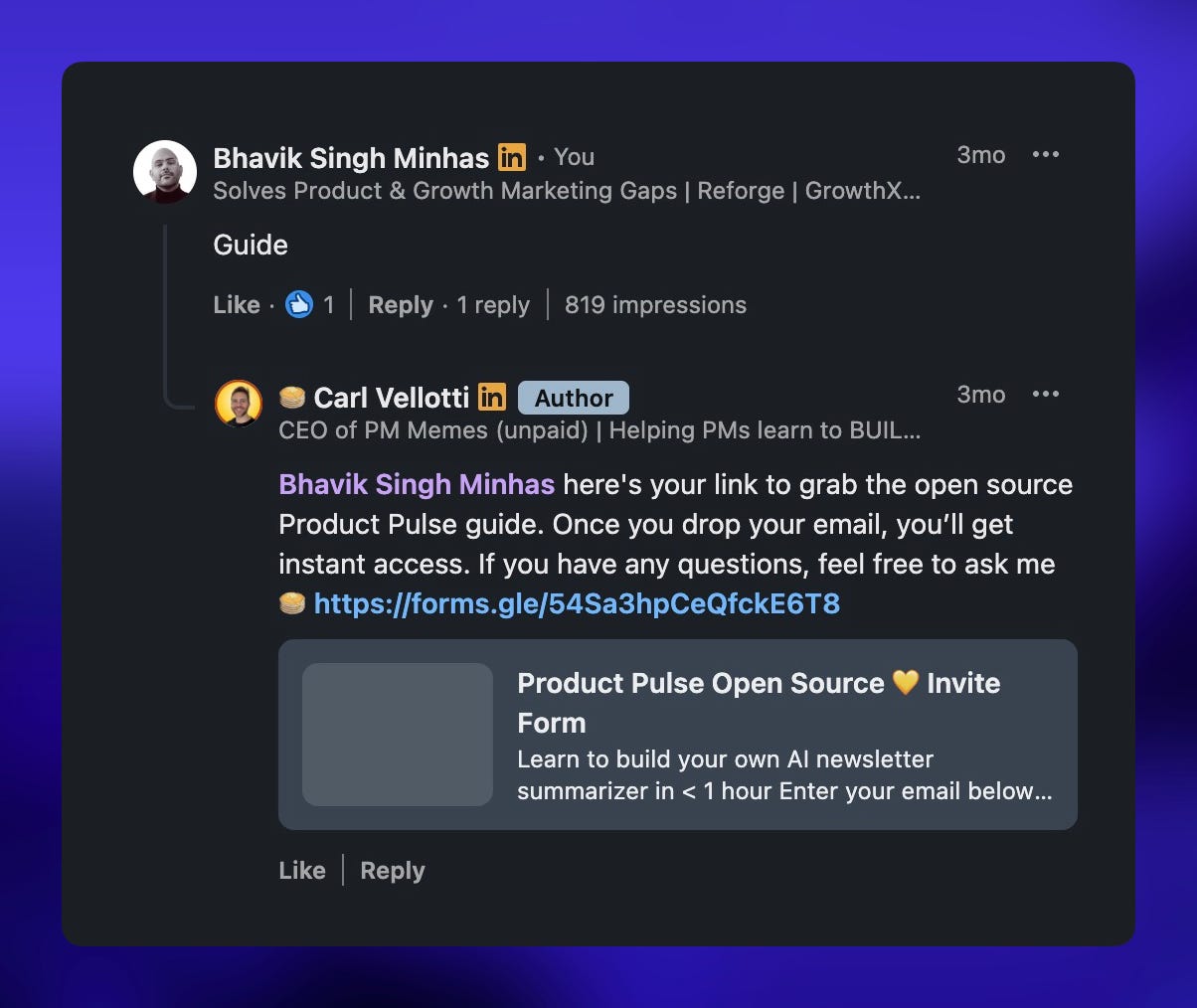
This keeps the ecosystem healthy and human.
It can get overwhelming if the post goes viral, but still try to close loops.
5. Open a clean direct channel
Once you’re DM’ing, act like a human.
You don’t need a sales pitch.
A simple:
“Hey! Here’s the resource you asked for. Hope it helps.”
Goes a long way.
Dwight Schrute said it best…

6. Avoid the silent drop off
One drawback to this tactic, and the only way people usually fail with this, is by not following up.
Comment captured, link sent, and then?
And then… nothing.
No reply.
No follow-up.
No conversation.
No relationship.
Just a link floating in a DM thread like:
“Here you go 👍”

Fatigue might set in due to the overwhelming response, and creators might feel the job is finished.
But if there are no feedback loops, the bigger opportunity window closes.
And it’s where this system quietly fails.
7. Ask a low-effort, open-ended question
It’s where most people mess up.
They either:
Ask nothing (conversation dies), or
Ask something heavy (“What are you building?”) too early.
Instead, ask something easy to answer and directly related to why they commented.
Example DM: Soft engagement question
Out of curiosity, what made you interested in this?
Are you working on something similar right now?
This does three things:
It respects context
Filters intent naturally
Invites conversation without forcing it
If they reply, do not jump into a pitch. Mirror first.
Example Response
That makes sense. A lot of people run into that exact issue.
Which part has been the trickiest so far?
You’re diagnosing, not closing.
And it keeps the interaction functional, safe, and non-threatening.
8. Only offer help when it’s earned
You earn the right to offer something after:
They explain a problem.
Ask a question.
Signal curiosity.
When you get that nod, that’s the time to strike.
Here’s an example transition
If it helps, I’ve seen a couple of ways teams solve this.
Happy to share what’s worked if you want.
But remember, permission first. Always.
And when they do, don’t continue the conversation on a different platform, like email, before asking. It destroys what you’ve already built on one platform.
You don’t want to start from scratch on another.
Final Thoughts
Comment-gating works because it creates a warm, inbound, permission-based conversation.
And it’s a user-invented feature waiting to be legitimized, which is precisely why platforms should start building it properly.
The first platform to formalize it properly won’t just clean up feeds.
They’ll own high-intent engagement in the creator economy.
It feels inevitable, no?
What say you? I’d love to read your thoughts on this.
And if you found this article interesting, comment INTERESTING. 😅